It’s 3AM. You’re awake when you shouldn’t be. Your thoughts are loud, your impulse control is gone, and something in you is reaching — for the phone, for the drink, for the habit you swore you were done with.
You’re going to call it weakness. You’re going to blame your character.
But here’s what’s actually happening: your brain is broken right now. Not permanently. Not because you’re fundamentally flawed. But because sleep deprivation has quietly dismantled the neurological architecture you need to make good decisions — and nobody told you that’s what was happening.
This is the conversation most recovery spaces won’t have with you. DS RAW | Mindset Engineering is having it anyway.
The Organ That Keeps You Sane Is the First Thing Sleep Deprivation Shuts Down
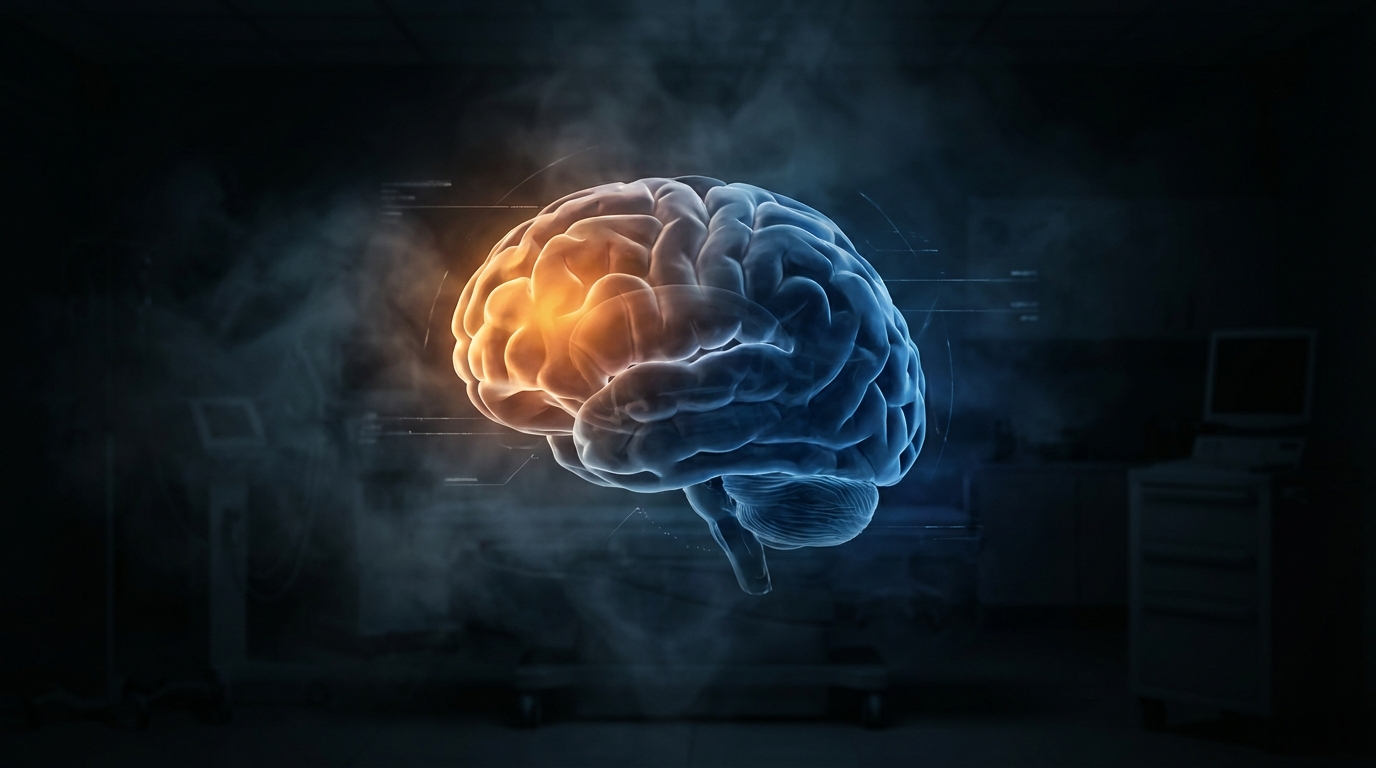
Your prefrontal cortex is the part of your brain responsible for weighing consequences, delaying gratification, and overriding impulse. It’s your willpower hardware. It’s the thing that says not yet when the rest of your brain is screaming right now.
After one night of poor sleep — even just 4 to 5 hours — prefrontal cortex function drops measurably. The research on this isn’t soft. Studies from the University of Pennsylvania and Walter Reed Army Institute of Research showed that sleep-restricted subjects performed as poorly on cognitive tasks as people who had been awake for 24 straight hours.
And here’s the part that should stop you cold: they didn’t know it. The subjects rated their own alertness as fine. Their subjective experience of competence was intact. But their actual decision-making was shredded.
You don’t get a warning signal when your prefrontal cortex goes offline. You just start making choices that would horrify your rested self — and you feel completely justified doing it.
The connection between sleep deprivation and self-control isn’t motivational. It’s anatomical.
Sleep Debt Is a Relapse Accelerant — Here’s the Chemistry
When you’re not sleeping, your body doesn’t just get tired. It shifts into a specific hormonal state that is, in every measurable way, a biological setup for bad decisions.
Cortisol spikes. Poor sleep triggers your stress response, flooding your system with cortisol — the hormone associated with threat detection, urgency, and survival-mode thinking. When cortisol is running your brain, everything feels like an emergency. Every craving has edge. Every discomfort feels unbearable. You’re not being dramatic; you’re being chemically hijacked.
At the same time, serotonin gets suppressed. Serotonin is your baseline sense that things are okay — that you can handle difficulty, that delayed gratification is worth it. Strip it out and the cost-benefit math of relapse changes entirely. What used to feel like a bad trade suddenly feels like the only logical move.
And then the amygdala — your threat and reward center — goes hyperactive. Without sleep, the amygdala lights up in response to stimuli at rates 60% higher than when rested, according to research published in Current Biology. This means cravings hit harder. Emotional pain hits harder. The pull toward old patterns hits harder. Not because you’ve gotten weaker — but because your brain’s threat-reward system is running without the brake pedal.
This is what DS RAW | Mindset Engineering means when we say lack of sleep causes relapse. It’s not metaphor. It’s a specific sequence of neurochemical events that make the next bad decision feel biologically inevitable.
You’re not failing your recovery when this happens. You’re running an experiment in brain sabotage and expecting different results.
The 3AM Pattern — The Weak Loop Nobody’s Talking About
Here’s the pattern that shows up again and again in men who keep slipping:
You’re under stress. Sleep quality drops. Cortisol climbs. Self-control degrades. You make an impulsive decision. Shame spiral activates. Sleep quality drops further. Cortisol climbs higher. Self-control degrades more. The next slip comes faster.
That is a weak loop — and sleep debt is the mechanism that keeps it spinning.
The lie the weak version of you tells is that it was a moment of weakness. That you just need more willpower. That if you cared enough, you’d do better. So you white-knuckle it for a few days, don’t fix the sleep, and hit the wall again at 3AM when your prefrontal cortex is offline and your amygdala is in full riot mode.
Stop feeding the weak version of you by pretending this is a character problem. It’s a systems problem. And broken systems don’t get fixed with shame — they get fixed with engineering.
The sleep and addiction recovery connection isn’t soft science. The National Institute on Drug Abuse has documented that sleep disturbances are among the most significant predictors of relapse across substance use disorders. Men in early recovery who report poor sleep are dramatically more likely to slip than those who don’t. This isn’t anecdote. It’s epidemiology.
Your Brain at 3AM Is Not Your Brain — And That’s Not an Excuse, It’s a Protocol Requirement
Let’s be direct about something. Understanding the neuroscience of sleep deprivation is not permission to collapse. It is not an excuse to hand the wheel to your broken brain and say well, cortisol made me do it.
What it is, is a strategic demand. If you know your prefrontal cortex goes dark when you’re sleep-deprived, then protecting your sleep becomes part of your discipline infrastructure — not a comfort choice. Not self-care. Infrastructure.
If you were building a fortress, you wouldn’t leave the main gate open and unguarded and then wonder why your defenses failed. Your sleep is the gate. Right now, most of you are leaving it wide open.
Sleep deprivation puts your brain in a neurological state nearly identical to mild intoxication. Reaction time, impulse control, emotional regulation, consequence-weighing — all compromised on the same spectrum. You wouldn’t voluntarily show up to the hardest moments of your recovery slightly drunk. But that’s exactly what’s happening when you chronically run on 5 hours and call it discipline.
The prefrontal cortex willpower sleep relationship is not optional knowledge anymore. You’re either building around it, or you’re building on sand.
The Sleep Protocol for Men Who Think Sleep Optimization Is Soft
This isn’t a spa menu. This is a recovery and discipline protocol designed specifically for men in high-stress, high-temptation environments.
Implement this without negotiation:
Fix your anchor time first. Pick a wake time and lock it — non-negotiable, seven days a week. Not a bedtime. A wake time. This single variable does more to regulate your circadian rhythm than anything else, and a stable circadian rhythm directly stabilizes cortisol patterns.
Engineer a hard cutoff. No screens, no stimulating content, no alcohol, no intense conversations in the 60 minutes before bed. You are conditioning your nervous system. Every exception is re-conditioning it in the wrong direction. Pattern interruption here is mandatory — not occasional.
Drop the temperature. Your core body temperature needs to fall to initiate deep sleep. Keep your sleep environment between 65–68°F (18–20°C). This isn’t preference. It’s physiology.
Kill the cortisol spike before it starts. If you wake at 3AM with a racing mind, that is a cortisol spike — not a moral crisis. Do not reach for your phone. Do not start negotiating with your thoughts. Slow diaphragmatic breathing (4 counts in, hold 4, out 6) activates your parasympathetic system and interrupts the stress cascade. This is a pattern interruption — use it.
Track sleep debt like you track money. You don’t get to borrow indefinitely without paying. Every hour under your baseline (most men need 7–8) accumulates into functional impairment. Treat recovery sleep on weekends as debt repayment, not luxury.
Sunlight in the first 30 minutes of waking. This resets your circadian clock, suppresses residual melatonin, and primes your cortisol curve to peak at the right time — meaning it drops when it’s supposed to drop at night. Free. Brutally effective.
Remove the 3AM decision points. If your phone is in your bedroom at 3AM, you’ve already lost. If alcohol is accessible in your home at 3AM, you’ve already lost. The architecture of your environment needs to make relapse inconvenient before your prefrontal cortex goes offline — because once it does, you’re negotiating with a broken system.
The Self-Betrayal Hiding Inside Every Sleepless Night
Here’s what DS RAW | Mindset Engineering wants you to sit with:
Every night you stay up past your protocol, you are making a choice. You’re telling yourself the next day doesn’t matter. You’re telling yourself your standards have a bedtime. You’re telling yourself the work you say you’re committed to is negotiable.
That is self-betrayal. Not dramatic self-betrayal. Quiet, incremental, daily self-betrayal — the kind that compounds into a relapse you didn’t see coming.
The man who protects his sleep isn’t soft. He’s the man who shows up to hard moments with his full brain intact. He’s the man whose prefrontal cortex is online when the craving hits. He’s the man whose cortisol is regulated, whose amygdala isn’t running the show, whose discipline has a physiological foundation instead of just a motivational poster.
Stop performing toughness at the expense of your architecture. The reset starts with the basics — and sleep is as basic as it gets.
The Reset by DS RAW | Mindset Engineering is the complete system for men who keep slipping — including the full R.E.V.E.R.S.E. framework, the Relapse Protocol, and Reverse Mindset Engineering. Get the free first chapter at matrixcheatcode.com.