By DS RAW | Mindset Engineering
You didn’t relapse because you’re weak.
You relapsed because your life wasn’t interesting enough to compete.
That’s the part nobody says out loud. They hand you the hotline numbers and the meeting schedules and the breathing exercises — all the scaffolding for managing the symptom. But nobody asks the harder question: what are you actually going back to when you put the vice down?
If the answer is Netflix, silence, and a ceiling you’ve stared at too many times — you already know how this ends.
Boredom Isn’t a Mood. It’s a Relapse Mechanism.
Here’s the neuroscience, stripped of the academic padding:
Your brain runs on dopamine. Not happiness — anticipation. The reward circuit doesn’t fire when you get the thing. It fires when you’re about to get it. That gap between wanting and having is where your brain is most alive.
Your vice understood this perfectly.
Alcohol, porn, gambling, drugs, even doom-scrolling — every one of those vices was a direct line to artificial dopamine spikes in a nervous system that was starving for stimulation. They didn’t just give you pleasure. They gave you a reason to look forward to something. They gave your brain a project.
When you take that away without replacing the neurological function it was serving, you don’t get peace. You get a boredom-shaped hole that will hunt you down.
This is why boredom is a documented relapse trigger — not a mood, not a personality flaw, not a sign you need better willpower. It is a measurable neurological state where your brain’s reward circuitry is under-stimulated and actively seeking input. And if you haven’t deliberately built competing inputs, your brain will default to the fastest route back to what worked before.
The weak loop looks like this: remove vice → feel empty → feel bored → rationalize → relapse → shame spiral → repeat.
You’re not breaking the habit. You’re just orbiting it.
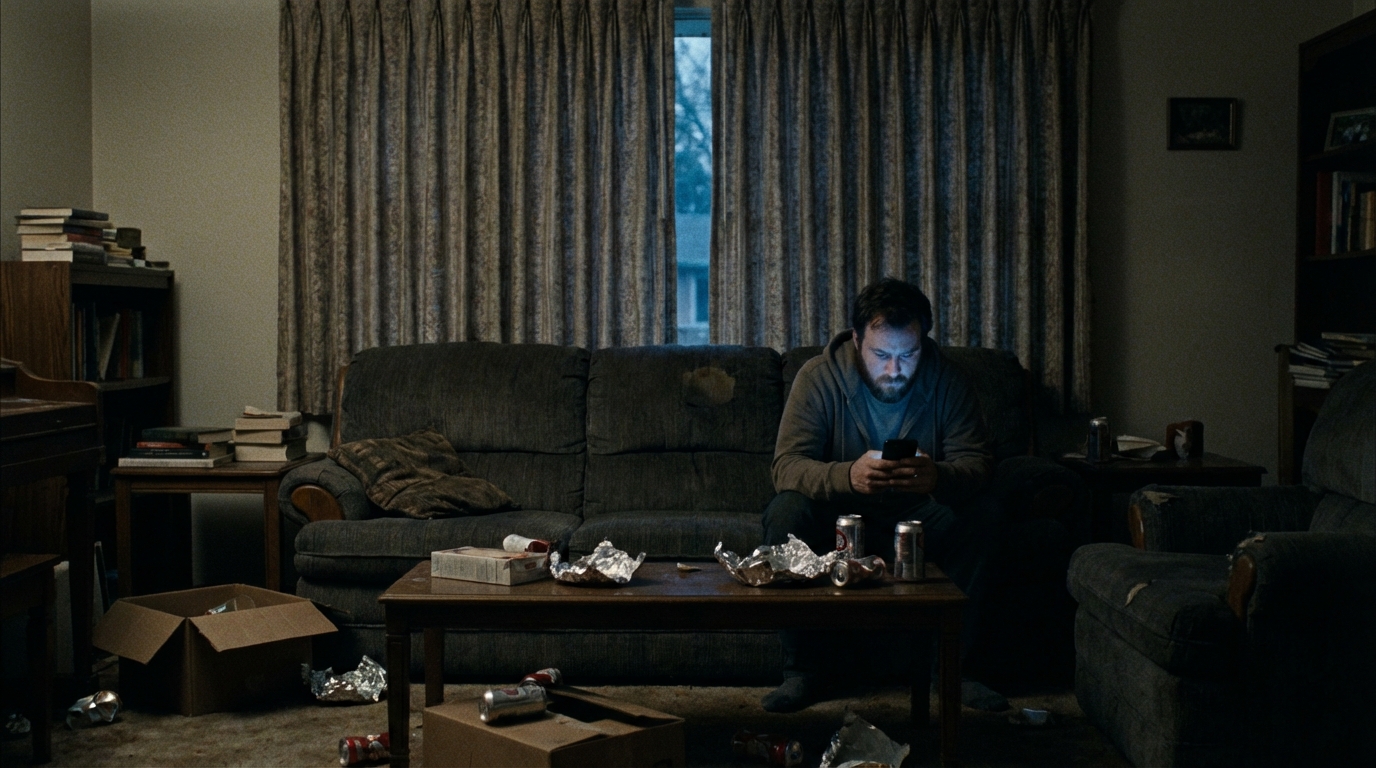
The Vacuum Principle: Why Willpower Always Loses to an Empty Life
Willpower is a resource. It depletes.
Every study done on self-control confirms this. It’s not a character trait you either have or don’t — it’s a finite daily budget, and most men are spending it fighting a battle that shouldn’t require willpower at all if the architecture of their life was built correctly.
Here’s the brutal truth about why men relapse when bored:
They’re trying to use discipline to hold a door shut that has nothing on the other side worth staying for.
Think about that. You’re white-knuckling your sobriety, resisting the pull of your vice, burning through mental energy every single day — and what’s on the other side of all that effort? What is the life you’re fighting for? If you can’t answer that in three sentences with genuine excitement, you have a vacuum problem, not a willpower problem.
Nature abhors a vacuum. So does your brain.
Something will fill the space. The question is whether you choose what fills it, or whether your old conditioning chooses for you.
Stop managing your addiction. Start building something that makes it irrelevant.
This is the shift that most recovery frameworks miss entirely. They’re obsessed with removal — remove the trigger, remove the access, remove the temptation. But removal without replacement isn’t recovery. It’s just a slower version of the same pattern interruption that never sticks.
Real pattern interruption doesn’t just block the old signal. It installs a stronger signal in its place.
The Stimulus Substitution Hierarchy: Building a Life That Competes
DS RAW | Mindset Engineering calls this the stimulus substitution hierarchy — and it’s the framework most men never get because nobody’s telling them the truth about what recovery actually requires.
Here’s the concept:
Every vice operates at a specific level of neurological intensity. Heroin hits different than beer. Gambling hits different than binge-watching. Your replacement behaviors need to be matched or exceed that intensity level — or your brain will always register them as inferior and keep sending you back to the original source.
This is why men who quit drinking and replace it with chamomile tea and journaling relapse.
Not because they lack discipline. Because chamomile tea cannot neurologically compete with alcohol in a brain that has been conditioned to expect a certain level of stimulation.
The hierarchy works like this:
Level 1 — Physical intensity. High-output physical training, combat sports, cold exposure, heavy compound lifts. This is non-negotiable as a base layer. Your body needs a legal, high-intensity dopamine and adrenaline pathway. If you’re not training hard, you’re not serious about replacing what the vice was chemically providing.
Level 2 — Mastery and novelty-seeking. Your brain’s addiction to novelty and progress is one of the most powerful forces in human psychology — and it’s the same force that makes vices so magnetic. Direct it toward skill acquisition. Learn something that has a steep learning curve: a language, an instrument, a martial art, a trade. The frustration-to-progress cycle in genuine skill-building mimics the tension-release loop of addiction — but it compounds over time instead of destroying you.
Level 3 — Mission and identity architecture. This is the deepest layer, and the one most men skip because it requires the most honesty. You need a reason to be alive that isn’t about comfort. A project that matters. A standard you’re building toward. A version of yourself that the vice is incompatible with — not because you decided to quit, but because the man you’re becoming doesn’t operate that way.
When you build all three levels, you’re not fighting your vice anymore. You’re outgrowing it.

The Novelty-Seeking Brain Is Not Your Enemy
Evolutionary psychology has a name for the pattern you’re caught in: novelty-seeking behavior.
Your brain was wired to seek new stimulation. For 200,000 years, that drive kept humans alive — always scanning for food, threat, mate, opportunity. The man who could sit in comfort and feel nothing was already dead.
Modern vices are engineered to hijack this exact circuit.
Slot machines, social media algorithms, pornography production — they are all designed by people who understand your neurology better than you do, and they built products that feed the novelty-seeking loop on demand, on repeat, without any real-world risk or effort.
And you walked in thinking it was about pleasure.
It was never about pleasure. It was about filling the evolutionary mandate your brain carries every single day — the requirement to be stimulated, challenged, and oriented toward something worth pursuing.
The answer isn’t to kill that drive. You can’t. And you’d be useless if you did.
The answer is to redirect novelty-seeking addiction recovery toward real-world pursuits that satisfy the same biological requirement — without the self-betrayal.
Every morning you wake up with the same stale routine and no forward momentum, you are setting yourself up. You are handing your novelty-seeking brain a blank check and leaving it in a room with your vice.
Fill the schedule before it fills itself.
What Building a Meaningful Life in Sobriety Actually Looks Like
Stop feeding the weak version of you. Here’s what this actually looks like in practice:
It looks like ruthless schedule architecture. You map out your week before it starts. Not because you’re a productivity guru — because an unstructured day is a relapse waiting to happen. Idle time is debt your future self pays.
It looks like chosen difficulty. You stop avoiding hard things and start engineering them into your day deliberately. Cold showers, hard training, uncomfortable conversations, skill practice that makes you feel incompetent before it makes you feel competent. Voluntary difficulty inoculates you against the easy escape.
It looks like identity-first decisions. You stop asking